List of Masonic symbols and their meanings
What secrets do the mysterious symbols of Freemasonry hide? How have they changed over time?
In this article, we will explore the world of Masonic symbols. We will understand their meaning and cultural influence. Freemasonry, born in England in the 17th century, is full of symbols and traditions.
Each symbol, such as the square and compass, represents important values. These symbols convey essential teachings in this secret society.
We will see how symbols such as the plumb line and level convey ideas of justice and balance. This exploration aims to unveil the mysteries surrounding Freemasonry. We hope to give you a better understanding of these enigmatic symbols.
Key Points to Remember
- Freemasonry developed in England at the end of the 17th century.
- Masonic symbols such as the square and compass represent values of morality and balance.
- The letter G is associated with Geometry and the Grand Architect of the Universe.
- The mosaic pavement symbolizes the union of opposites and the diversity of humanity.
- The All-Seeing Eye is one of the most recognized symbols of Freemasonry.
History and origin of Freemasonry
Freemasonry was born in Scotland in the 16th century. In 1598, William Shaw published statutes for the lodges. These rules governed the entry of new members and conflicts within the lodges.
In England, Freemasonry organized itself in the 17th century. It created Masonic obediences to structure its movement.
Beginnings in Scotland and England
Operative masons had lodges since the 13th century. They were used to store tools and discuss projects. The Book of Trades of 1261 defined the rules for masons and other artisans.
In 1472, the Company of Masons of London chose "God Is Our Guide" as its motto. Modern speculative Freemasonry appeared in Scotland in the 17th century. It developed in England with the creation of the Grand Lodge of London in 1717.
Structure and initiation rites
Freemasonry is organized into Masonic obediences. It has a wide variety of Masonic rites and traditions. Lodges, composed of about forty members, meet twice a month.
Initiation rituals are complex. They include esoteric, Christian, and other elements. This diversity shows the richness of Freemasonry.
Founding texts and evolution
Anderson's Constitutions of 1723 established the rules for Masonic obediences. Freemasonry has faced challenges and criticism. Masonic history studies this complex movement.
The historiography of Freemasonry is now recognized in academia. The legend that Freemasonry organized the French Revolution is a subject of debate.
Square and compass
The square and compass are key symbols of Freemasonry. They are often called "the square and compass." They symbolize the union of wisdom and action, reason and passion. These tools are also used to teach moral and spiritual lessons.
Origin and meaning
The square appeared in speculative Freemasonry in 1725. It represents integrity and moral rectitude. Traces of the square can be found in ancient monuments and sacred texts.
The compass symbolizes self-mastery and control over passions. It represents the path of life returning to its starting point. The sign of the setting sun recalls the square and invites rectitude.
Association with the letter G
The letter G, at the center of the square and compass, adds a dimension to their meaning. It represents "God" and "Geometry." It highlights the importance of spiritual and intellectual knowledge.
In summary, the square and compass symbol guides Freemasons in their quest for development. They remind them of the union between matter and spirit, temperance and rectitude.
The letter G in Freemasonry
The letter G in Freemasonry is a very important symbol. It has several meanings depending on traditions and Masonic degrees. It represents ideas such as Geometry, Generation, Gravitation, Gnosis, and the Grand Architect of the Universe.
Meaning and multiple interpretations
There are several interpretations of the letter G in Freemasonry:
- Geometry, highlighting the importance of mathematics in the structure of the Universe
- Grand Architect of the Universe, representing a divine or creative entity
- Gravitation, evoking the invisible forces that maintain cosmic harmony
- Generation, symbolizing birth and creation
- Gnosis, indicating the quest for spiritual knowledge
The interpretations of the letter G show its symbolic richness. Its meaning changes according to degrees and Masonic rites. It ranges from the initial of God in Anglo-Saxon traditions to a symbol of Geometry among French Freemasons.
Presence in various Masonic degrees
The letter G appears differently in each Masonic degree. In the Ancient and Accepted Scottish Rite (AASR), it is linked to five key terms: Geometry, Generation, Gravitation, Genius, and Gnosis. In higher degrees, it takes on deeper meanings, linking matter and spirit, Earth and Heaven, or God and man.
In summary, the letter G is much more than a simple letter. It is a central element of Masonic teachings, spanning different Masonic degrees and cultural traditions.
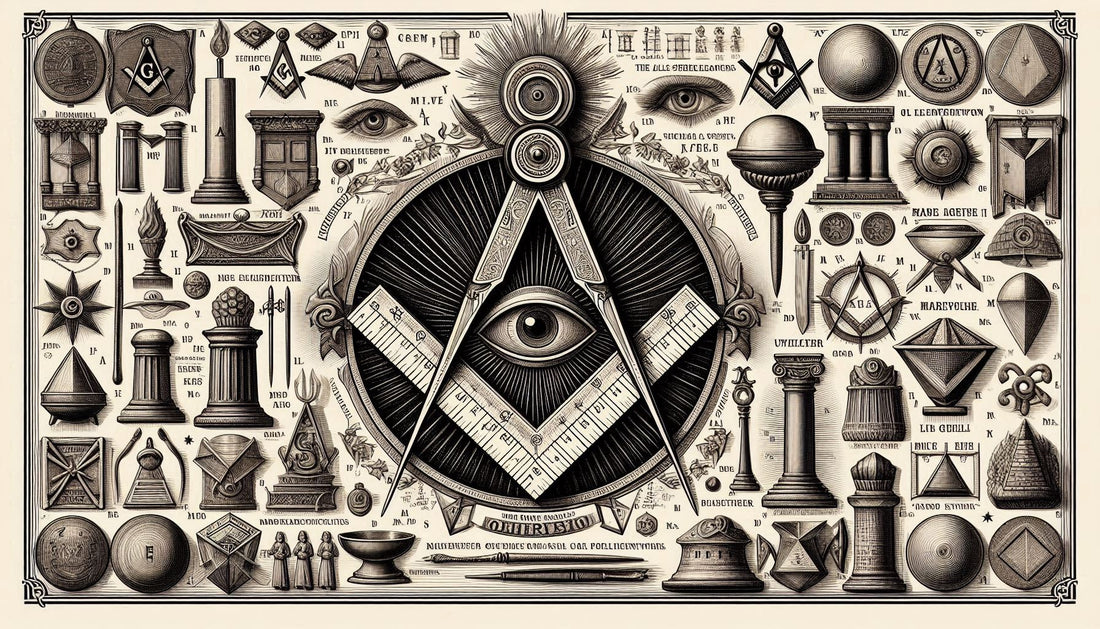
List of Masonic symbols and their meaning
Freemasonry was born in England in the 17th century. It has gathered many symbols. We will show you what these symbols mean and their importance in Freemasonry.
- The square and compass: The most well-known symbol, it represents morality and wisdom.
- The letter G: At the degree of Fellowcraft, it symbolizes Geometry and the Grand Architect.
- The plumb line: At the degree of Apprentice, it shows the link between the divine and the human.
- The mosaic pavement: It represents the union of opposites and the diversity of humanity.
- The columns Jakin and Boaz: They symbolize strength and beauty, the harmony of opposites.
- The blazing star: At the degree of Fellowcraft, it represents knowledge and free thought.
- The anchor: It represents hope and peace in the face of life's challenges.
- The hammer: It symbolizes authority and moral purity.
- The corn: Used in ceremonies, it evokes generosity.
- The coffin: It symbolizes mortality or immortality depending on the Masonic context.
Masonic symbols offer a wide variety of images and objects. Each symbol helps Freemasons learn and reflect. They remind them of their oath of morality, fidelity, and unity.
The symbolism of the mosaic pavement and the columns
In Freemasonry, symbols are very important. The mosaic pavement and the columns of Jakin and Boaz are examples. They are at the heart of Masonic lodges and help to understand the rituals.
Mosaic pavement: Union of opposites
The mosaic pavement, made of black and white tiles, shows duality. The black and white tiles represent the negative and positive sides of life. This pattern is often seen in rituals, such as that of the Memphis-Misraïm rite.
The mosaic pavement reminds us of the importance of balance between opposites. It is not about good versus evil, but about integrating these oppositions for harmony. The lines and dots of the pavement symbolize the cross and reconciliation.
Columns J and B: Harmony of opposites
The columns Jakin Boaz , at the entrance of the lodges, symbolize the harmony of opposites. They guide members toward a deeper knowledge. The column of Jakin is strength, and that of Boaz is beauty.
These columns represent more than architectural elements. They symbolize spiritual and philosophical concepts. They encourage finding the balance between shadow and light, and seeking union.
In conclusion, the mosaic pavement and the columns Jakin Boaz are essential. They help us navigate between opposites and find harmony. They show us that integrating differences leads to understanding and balance.
Conclusion
We have explored the fascinating world of Freemasonry. Masonic symbols are essential, for members and for those interested in Freemasonry. They offer depth and esoteric meaning.
Masonic symbols, often linked to the Bible, help us reflect and learn. They allow Freemasons to dialogue with the past. These symbols express the duality of life, with its luminous and dark aspects.
Vocabulary and rituals vary according to rites and countries. Traditions, such as the agape and initiation rituals, symbolize sharing and spiritual progression. These symbols strengthen the bonds of fraternity and solidarity.
Understanding Masonic symbols enlightens us on each member's path. They invite us to build an inner temple, that of Humanity. Freemasonry guides us toward personal transformation and spiritual elevation.